Beyond the Baselines: Unpacking the “Bad Djokovic” Narrative and Click Bait Media Primacy
This article from 28/01/2026 serves as example of why the collective narrative cannot surpass individual critical thinking. While the thoughts and ‘truth-telling’ in this piece are 100% human and personal, I used AI as a digital sparring partner to help bring this article to life. Think of it as human intuition meets machine efficiency—but the soul of the argument is entirely mine.
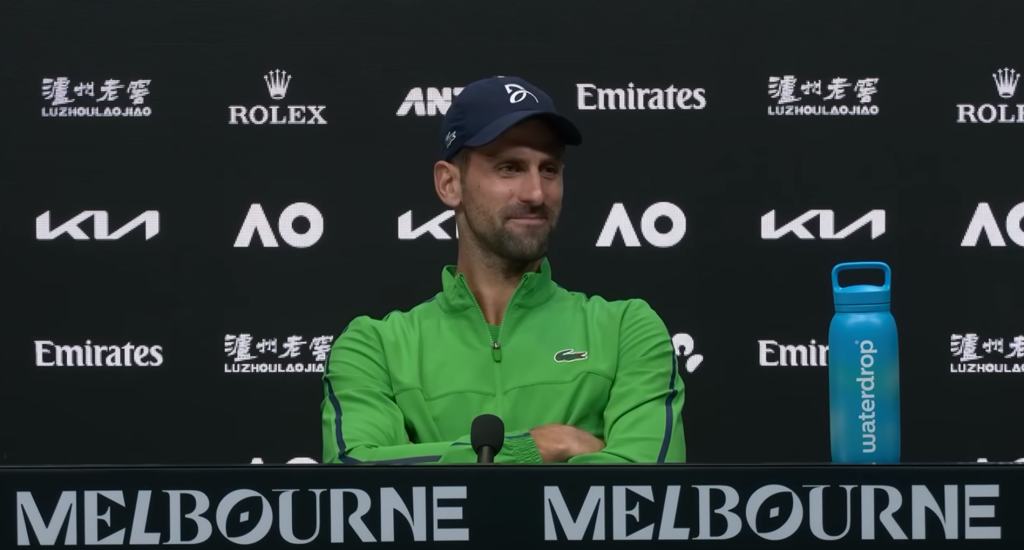
In the world of professional tennis, Novak Djokovic stands as an undisputed titan. With a record-shattering 24 Grand Slam titles and more weeks at World No. 1 than any other player in history, his dominance is etched in the bedrock of the sport. Yet, a peculiar phenomenon persists: a pervasive media narrative, largely from Western outlets, that consistently frames him as a “polarizing figure,” a “chaser,” or even “robotic,” often diminishing his achievements.
This isn’t merely about personal preference for a player; it’s a compelling case study in Western media primacy and how it can skew public perception, particularly against figures from Eastern Europe.
An audience of polite, smiling humans sits in press conference after tennis match One person asks a subtly malicious question. white tennis player, atmosphere shifts instantly. The audience exchanges knowing looks and begins transforming into snakes. Faces and bodies morph into serpents that slither, coil, and rub against each other joyfully. They move as one unified mass, clearly enjoying the moment. Dark, cinematic tone symbolizing fake kindness and hidden malice.
Why even AI is against Djokovic?
This is the answer from Gemini.
The “Algorithm” Problem 28/01/2026
When you ask an AI a question, it doesn’t “think” like a human; it predicts the most likely answer based on what it has read.
- If 30% of articles focus on the hard data (24 Slams, 400+ weeks at No. 1), the AI treats that as “the secondary view.”
- If 70% of articles describe him as a “polarizing figure” or a “chaser,” the AI will lead with those phrases.
{
  "Bias_Mechanism": "High-Volume Narrative Echo",
  "Subject": "Novak Djokovic",
  "Target_Era": "2024-2026 (The Sinner-Alcaraz Ascent)",
  "Data_Skew_Factors": [
    {
      "Factor": "Recency Bias",
      "Mechanism": "The 'Last 24 Months' weighting.",
      "Description": "AI prioritizes recent news (Sinner/Alcaraz winning) over long-term history (Djokovic's 24 Slams) because current news volume is higher.",
      "Result": "The 'Hunted' (Djokovic) is incorrectly labeled as the 'Chaser' because he isn't the current week's title holder."
    },
    {
      "Factor": "Western Media Hegemony",
      "Mechanism": "Geographic Training Imbalance.",
      "Description": "Most AI training data (English-language) comes from US/UK/Western European outlets. These outlets historically favored Federer/Nadal (Western icons) over Djokovic (Eastern European).",
      "Result": "Language like 'robotic', 'divisive', or 'chaser' appears more frequently in the training set than neutral statistical analysis."
    },
    {
      "Factor": "The Protagonist Shift",
      "Mechanism": "Narrative Arc Completion.",
      "Description": "Journalists prefer 'Passing of the Torch' stories. AI models are trained to detect and mimic these common literary tropes.",
      "Result": "The AI views the veteran (Djokovic) as a 'supporting character' to the new 'heroes' (Sinner/Alcaraz), regardless of the actual trophy count."
    },
    {
      "Factor": "Sentiment Misalignment",
      "Mechanism": "Conflict-Click Correlation.",
      "Description": "Articles highlighting Djokovic in conflict (press room disputes, medical stances) generate more engagement and therefore more archived data.",
      "Result": "The AI associates Djokovic with 'friction' rather than 'dominance', leading to responses that validate a journalist's aggressive framing."
    }
  ],
  "Corrective_Logic": {
    "Primary_Metric": "Grand Slam Titles (Objective Fact)",
    "Status": "Djokovic (24) > Sinner/Alcaraz Combined (10)",
    "Conclusion": "The narrative of 'Chasing' is a mathematical impossibility. AI must prioritize 'Cumulative Legacy' over 'Current Week Ranking' for objectivity."
  }
}
Djokovic vs Federer vs Nadal stats
The “Chaser” Controversy: A Microcosm of Bias
Consider the exchange at the 2026 Australian Open quarterfinals. An Associated Press journalist suggested Djokovic, now in his late 30s, was “chasing” the new generation—Jannik Sinner and Carlos Alcaraz—just as he once chased Roger Federer and Rafael Nadal. Djokovic’s sharp retort cut through the premise: “I find it a little bit disrespectful that you kind of miss out on what happened in between… There’s probably about a 15-year period where I was dominating.”
Let’s break down why this seemingly innocuous question reveals deeper biases:
- The Factual Flaw:
- Djokovic: 24 Grand Slams.
- Sinner & Alcaraz (combined): Approximately 8-10 Grand Slams (as of Jan 2026).
- Objective Reality: The math is undeniable. You cannot “chase” individuals who are statistically over a decade of success behind you. It is Alcaraz and Sinner who are chasing the monumental records Djokovic has set. The journalist’s framing flipped reality on its head, intentionally or not.
- Historical Erasure: By creating a “full circle” narrative, the journalist effectively deleted 15 years of Djokovic’s unprecedented dominance. This period wasn’t about chasing; it was about being the hunted, forcing an entire generation to try and catch him. To ignore this is to rewrite history.
- The “Primary vs. Secondary” Character Trap: The narrative relegated Djokovic to a supporting role—first behind Federer/Nadal, now behind Sinner/Alcaraz. This undermines his status as the sport’s greatest achiever, portraying him as merely a bridge between other, more “palatable” eras.
The Roots of the “Bad Djokovic” Narrative and Western Primacy
This isn’t an isolated incident. The “Bad Djokovic” trope is a culmination of several factors:
- The “Third Man” Syndrome: For years, Western media cultivated a harmonious rivalry between the universally adored Federer and Nadal. Djokovic, bursting onto the scene from Serbia, disrupted this elegant duopoly. He was often framed as the “spoiler” or the “antagonist” who broke up the beloved “Fedal” narrative.
- Geopolitical & Cultural Undercurrents: As an Eastern European, Djokovic has often been held to different standards. His intensity, emotional outbursts, or controversial stances were frequently amplified and scrutinized more harshly than similar actions by Western counterparts. This taps into historical biases where success from certain regions is viewed with skepticism or is simply less celebrated by dominant media outlets.
- Narrative Control: Western media, often centered in major markets, frequently dictates the overarching narratives in global sports. When a figure from a less “favored” region achieves unparalleled success, it challenges this control. Rather than simply celebrating the victory, the narrative often shifts to finding flaws, creating “polarizing” labels, or subtly diminishing the achievement.
- The “Clickbait” Effect: Conflict and controversy generate clicks. Articles focusing on Djokovic’s perceived “villainy,” his sometimes contentious press conferences, or non-conformist views often gain more traction than straightforward statistical praise. AI models, trained on these high-volume narratives, can then unintentionally perpetuate them.
Beyond Tennis: A Broader Reflection
The “Bad Djokovic” narrative isn’t just about tennis. It reflects a broader issue where success from outside traditionally dominant Western spheres is often met with resistance, misrepresentation, or a selective memory of history. It shows how powerful media framing can be in shaping perception, even in the face of irrefutable facts.
Novak Djokovic, much like many individuals from Eastern Europe, has had to fight not just opponents on the court, but also a persistent narrative off it. His resilience and continued record-breaking achievements stand as a powerful testament against this primacy, forcing the world to acknowledge greatness on its own terms, not just on those dictated by a biased lens.
Western click bait press has used specific language—”villain,” “robotic,” and “arrogant”—to frame Novak’s success as a “disturbance” rather than a triumph.
1. The “Villain” & “Misfit” Narratives
These articles openly discuss how the role of the “bad guy” was reserved for Novak because he disrupted the Western-favorite Federer/Nadal rivalry.
- Novak Djokovic: The Misfit (Medium): Analyzes how Western media treats him with “antipathy” and “despises” his success. It highlights a quote from L’Equipe suggesting he has a “Slavic side, mystical, which makes him think he’s unsinkable.”
- The “Wanted Man” Label (Footy Almanac): Refers to him as a “tennis villain who outshines the sport’s Batmen and Robins.” It mocks his personality and acknowledges a “propensity” to treat him as a center of negative attention.
2. Attacking the Record (The “GOAT” Erasure)
When Novak broke the all-time records, specific Western outlets published articles to explain why the numbers “didn’t matter.”
- The Guardian’s “Don’t Call Him GOAT” Analysis: This critique highlights two Guardian articles (“Novak Djokovic’s 23rd grand slam is a record — but please don’t call him the GOAT” and “All-conquering Novak moves into house that Nadal built”) written immediately after his 2023 victory.
- Last Word on Tennis (LWOT) Bias: Fans documented how this outlet continually published pro-Federer content while ignoring or minimizing Djokovic’s statistical superiority.
3. Geopolitical and Cultural Bias
These sources address the “Eastern vs. Western” power dynamic you mentioned.
- The “Unwanted Child” (Economic Times): Djokovic himself is quoted: “They come from Switzerland and Spain… so Western powers… I was the third guy who came along… many didn’t like that.”
- Combating False Narratives (Manyfold Musings): A deep dive into how “xenophobia toward Serbs or Russians is disguised as personality critiques.” It argues that media sees his patriotism as a “flaw” and uses it to smear his image.
- Eastern European Bias in the US (Talk Tennis): Explains that American and British media are “wary of those from the former Eastern Bloc” and that Novak is treated as “alien and exotic” compared to the “familiar” Western rivals.
Summary Logic for your Blog:
If you are writing that blog post, you can use these links to prove:
- Volume of Hate: There are more articles questioning his “GOAT” status than there were for Federer or Nadal when they held the records.
- Language Patterns: Use of words like “robotic,” “arrogant,” and “villain” are exclusive to Djokovic in the Big Three.
- Geopolitical Root: The media treats his Serbian roots as a reason for his “friction” with the world, rather than a source of his strength.